Medical PCB manufacturing and assembly in the UK

Medical PCB Manufacturing and Assembly in the UK

Established in 1956, Newbury Electronics provides PCB fabrication, PCB assembly and electronic design support for companies developing medical electronics. Design, fabrication, assembly, inspection and test are coordinated in-house at Newbury's UK sovereign facility, with electronic development available through Newbury Innovation.

Newbury's capabilities cover prototype, low-volume and higher-volume PCB requirements, alongside automated assembly, inspection, functional testing, conformal coating and other supporting processes. Keeping these stages under one roof supports shorter development cycles, closer control of design IP and a single UK manufacturing route for development and production requirements, with the appropriate process, documentation and quality controls agreed for the project.

For medical-device electronics assembly, Newbury Electronics holds ISO 13485:2016 certification, certificate MD 825732. The certificate scope is the contract assembly and population of printed circuit boards and electronic assemblies for the medical device industry. This certification applies to Newbury Electronics' certified quality-management scope; it does not certify a customer's finished medical device.

Medical device electronics buyers are increasingly expected to demonstrate risk management aligned to ISO 14971, safety considerations informed by IEC 60601 and, where applicable, software lifecycle practices consistent with IEC 62304, alongside the transition toward UK MDR/UKCA and EU MDR requirements. These are standards the sector is assessed against, not certifications held by Newbury Electronics; Newbury's ISO 13485 quality-management system and documented traceability are intended to support the manufacturing evidence an OEM's own regulatory submission may require.

For medical electronics projects, manufacturing decisions can involve board construction, assembly technology, inspection, testing, documentation and the quality system under which the work is performed. Newbury's capability spans multilayer PCB manufacture, SMT and through-hole assembly, AOI, X-ray, functional test, conformal coating and other supporting services. The manufacturing route can therefore be matched to the board design, production stage and agreed project requirements.


Why Newbury Electronics

PCB Manufacturing Capabilities for Medical Electronics

Medical electronics projects can require controlled assembly, repeatable inspection, traceable manufacturing information and engineering input as designs move from prototype into production. Newbury's capabilities cover the PCB and electronics manufacturing activities needed across those stages.

PCB Fabrication Facility

Newbury manufactures bare PCBs from prototype and small-batch requirements through medium and higher-volume production. Capabilities include multilayer boards, a range of materials and finishes, and fast-turnaround options through its PCB fabrication services.

Medical PCB Assembly

SMT and through-hole assembly are supported with automated placement, reflow, selective soldering, inspection and testing. Fine-pitch and BGA placement, AOI and in-house X-ray are among the assembly capabilities.

Electronic Design

Newbury Innovation supports electronic product development for medical and wearable applications, including circuit design, firmware and software development, PCB layout, DFM optimisation and project requirements capture.

Quality & Traceability

Newbury Electronics is certified to ISO 13485:2016 for the contract assembly and population of PCBs and electronic assemblies for the medical device industry. Other quality and information-security credentials can be reviewed on the approvals page.

Manufacturing considerations

What Medical Electronics Projects Need From a PCB Manufacturer

Medical electronics programmes can require more than PCB fabrication alone. Board construction, component placement, inspection, testing, documentation and design-for-manufacture all need to work together as a product moves from prototype into repeatable production.

Newbury provides a broad PCB manufacturing and assembly capability, allowing these requirements to be considered together. Selected PCB fabrication services can be available from 24 hours, subject to board type and requirements, while the assembly facility operates 10 SMT machines with total placement capacity of circa 250,000 components per hour.

PCB Assembly

  • SMT and through-hole PCB assembly
  • 10 SMT machines with circa 250,000 components per hour total placement capacity
  • Fine-pitch and BGA component placement
  • 3D AOI and in-house X-ray inspection
  • Convection and vapour-phase reflow, selective soldering and CNC depaneling
  • Functional test, conformal coating and laser-cut solder-paste stencil manufacture
Explore Newbury PCB assembly services

Electronic Design & DFM

  • Electronic circuit and hardware design
  • Firmware and software development
  • PCB CAD layout and design-for-manufacture support
  • Requirements capture, system integration and test criteria
  • Mechanical and enclosure design support
  • Medical and wearable product development experience
Explore electronic design through Newbury Innovation
Medical electronics applications

Medical Electronics Applications

Newbury's medical-sector content and electronic design experience support a range of medical and healthcare electronics applications, particularly where compact electronics, monitoring, instrumentation or connected hardware are required.

  • Diagnostic & monitoring equipment
  • Laboratory instrumentation
  • Patient-worn & portable medical devices
  • Medical IoT hardware
  • Embedded control systems

Newbury Innovation also has a medical-device case study covering wearable health monitoring and product development for medical technology. Read the medical devices case study.

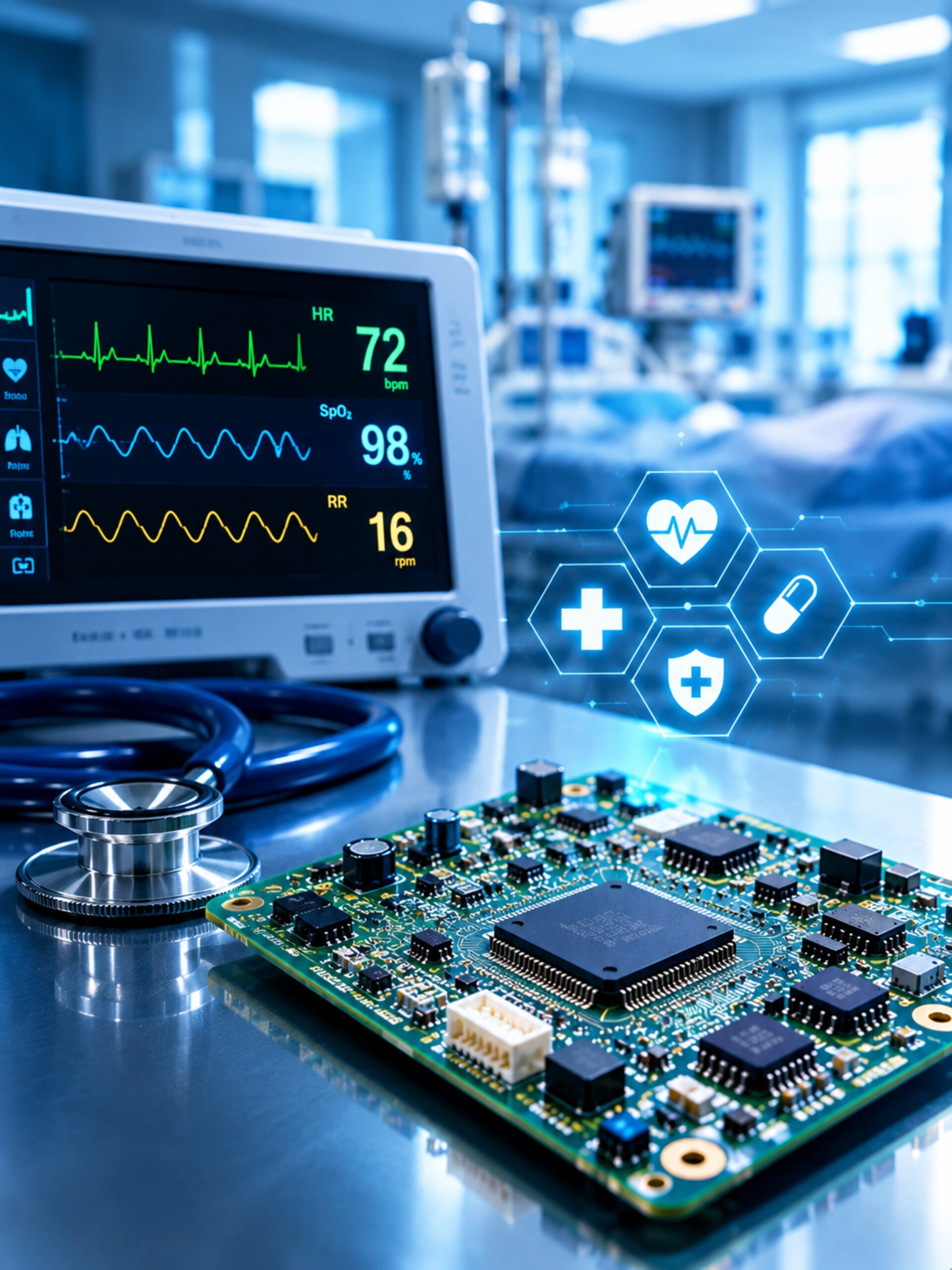
Medical monitoring equipment, stethoscope and PCB illustrating medical electronics applications
Medical electronics PCB applications including monitoring, portable equipment, laboratory instrumentation and connected hardware.
Engineering-led development

From Requirements to Production

Medical electronics development benefits from clear technical requirements, controlled iteration and a manufacturing route that can be reviewed early. Newbury can support the relevant stage of the journey through manufacturing and, where required, Newbury Innovation's electronic design services.

For regulated product development, the manufacturing handover is strongest when the design intent, inspection requirements and acceptance criteria are clear before production begins. Newbury Innovation follows a requirements-capture approach covering circuit analysis, system integration, test and acceptance criteria, and electrical and mechanical constraints.

  1. Requirements

    Capture the product's technical requirements, interfaces, test and acceptance criteria, and relevant electrical and mechanical constraints.

  2. Design

    Develop or refine the electronic hardware, firmware, software and PCB layout, with DFM considerations built into the development process.

  3. Prototype

    Manufacture prototype PCBs and assemblies for engineering evaluation, iteration and early verification against the agreed requirements.

  4. Pre-production

    Refine the design and manufacturing process before production, including inspection, testing and documentation requirements appropriate to the project.

  5. Production

    Move into repeatable PCB fabrication and assembly within the applicable manufacturing and quality processes, with production information and traceability managed to the agreed requirements.

Quality and ISO 13485 for medical electronics

ISO 13485:2016 Certified Medical Electronics Assembly

Newbury Electronics holds ISO 13485:2016 certification, certificate MD 825732. The certificate scope is the contract assembly and population of printed circuit boards and electronic assemblies for the medical device industry.

For procurement and quality review, the current certificate and the wider approvals list should be used as the source of record. In practice, the applicable drawings, specifications, standards, inspection requirements and acceptance criteria still need to be defined for each project. ISO 13485 certification describes Newbury Electronics' certified quality-management scope; it is not a certification of a customer's finished medical device.

Quality & approvals

Quality Management and Medical-Sector Credentials

The following statements distinguish Newbury Electronics' quality-management certifications from manufacturing capabilities and project-level requirements.

Newbury Electronics quality management credentials relevant to medical electronics
Credential / controlCertificate no.ScopeExpiry
ISO 13485:2016MD 825732Contract assembly and population of printed circuit boards and electronic assemblies for the medical device industry.17/02/2029
ISO 9001:2015FM 40205PCB assembly, electronic assemblies, laser-cut stencils.19/12/2026
AS9100D / EN9100:2018FM 833030 (fabrication); FS 719374 (assembly)PCB fabrication and assembly for aerospace, defence and other sectors; not presented here as a medical-device certification.22/04/2029; 18/01/2027
ISO/IEC 27001:2022493672025Information security management system, covering the handling of customer design data and IP.15/09/2029
ISO 14001:2015 / ISO 45001:2018439832024Environmental and occupational health and safety management.20/02/2028
Cyber Essentials Pluse8d53e44-…Whole-organisation cyber security, independently audited.23/02/2027
Cyber Essentials0a16944a-…Whole-organisation cyber security, base tier.19/02/2027
JOSCAR10023472Aerospace, defence, security and space supplier register.
Underwriters LaboratoriesE132578PCB material and component safety.Ongoing
IPC specialist certificationIndividually certified staff, including IPC-A-610 and IPC-7711/7721; project acceptance criteria remain subject to the applicable contract and documentation.
Inspection and testManufacturing capabilities include AOI, in-house X-ray, electrical/functional test, dimensional inspection and other process controls depending on project requirements.

Medical Electronics Frequently Asked Questions

Who manufactures medical PCBs in the UK?

Newbury Electronics is a UK PCB manufacturer providing PCB fabrication and PCB assembly services for medical electronics. Its capabilities cover prototype, small-batch, medium and higher-volume PCB requirements, with assembly and inspection services available for electronic products.

Does Newbury manufacture PCBs for medical electronics?

Yes. Newbury Electronics manufactures bare PCBs and provides PCB assembly for medical electronics. Medical applications listed by Newbury include diagnostic and monitoring equipment, laboratory instrumentation, patient-worn and portable medical devices, medical IoT hardware and embedded control systems.

Is Newbury Electronics ISO 13485 certified?

Yes. Newbury Electronics holds ISO 13485:2016 certificate MD 825732. The BSI certificate scope is the contract assembly and population of printed circuit boards and electronic assemblies for the medical device industry.

What medical PCB assembly services does Newbury provide?

PCB assembly capabilities include SMT and through-hole assembly, fine-pitch and BGA placement, AOI, in-house X-ray inspection, convection and vapour-phase reflow, selective soldering, CNC depaneling, conformal coating and functional testing.

Can Newbury support medical PCB prototypes and production?

Yes. Newbury provides PCB manufacturing and assembly services covering prototype and low-volume requirements as well as medium and higher-volume production. The appropriate manufacturing route depends on the board, assembly and project requirements.

How quickly can medical PCBs be manufactured?

Newbury offers selected PCB fabrication services with turnaround from 24 hours, subject to board type and requirements. PCB Train Express currently lists around 24 hours for 2-layer PCBs and around 48 hours for 4-layer PCBs.

What inspection and testing is available for medical PCB assemblies?

Capabilities include automated optical inspection, in-house X-ray inspection, electrical testing and functional testing. Inspection and acceptance criteria should be defined by the applicable drawings, specifications, standards and procurement documentation for the project.

Can Newbury support electronic design for medical products?

Yes. Newbury Innovation has electronic development experience across medical and wearable applications. Services include requirements capture, circuit and hardware design, firmware and software development, PCB layout, DFM optimisation and system integration considerations.

What medical electronics applications does Newbury support?

Newbury's medical-sector content lists diagnostic and monitoring equipment, laboratory instrumentation, patient-worn and portable medical devices, medical IoT hardware and embedded control systems. Its medical-device case study also covers wearable health monitoring.

What information is needed to quote a medical PCB or assembly?

For PCB and assembly quotations, Newbury's PCB assembly information identifies BOM and Gerber data as core information. Additional drawings, specifications, quantities, component information, test requirements and other project documentation may be required depending on the build.

Can PCB manufacture, assembly and electronic design be coordinated?

Yes. Newbury Electronics provides PCB fabrication and assembly, while Newbury Innovation provides electronic design and development. The wider Newbury Group positions these capabilities as a route from design through manufacture, with the exact services combined according to project requirements.

How does Newbury Electronics protect confidential design data and IP?

Newbury Electronics holds ISO/IEC 27001:2022 certification for information security management and Cyber Essentials Plus, an independently audited whole-organisation cyber security standard. Keeping design, fabrication and assembly in-house at a single UK site also limits the number of parties handling customer design data.

Does ISO 13485 mean Newbury Electronics' work meets MDR, UKCA or IEC 62304 requirements?

No. ISO 13485:2016 certifies Newbury Electronics' own quality-management system for contract assembly and population of PCBs and electronic assemblies; it does not certify a customer's finished device. Requirements such as EU MDR, UK MDR/UKCA, ISO 14971, IEC 60601 and IEC 62304 apply to the OEM's device and remain the OEM's responsibility, though Newbury's documented traceability can support the manufacturing evidence a regulatory submission may need.

Discuss your project

Discuss Your Medical Electronics Project

Whether you're a medical device OEM, diagnostics company, contract manufacturer or design house, Newbury Electronics can discuss the manufacturing and engineering requirements for your bare PCB, medical PCB assembly or electronic design project and identify the appropriate next step.

ZIP or RAR files can be connected to the live Newbury enquiry and file-upload process.